
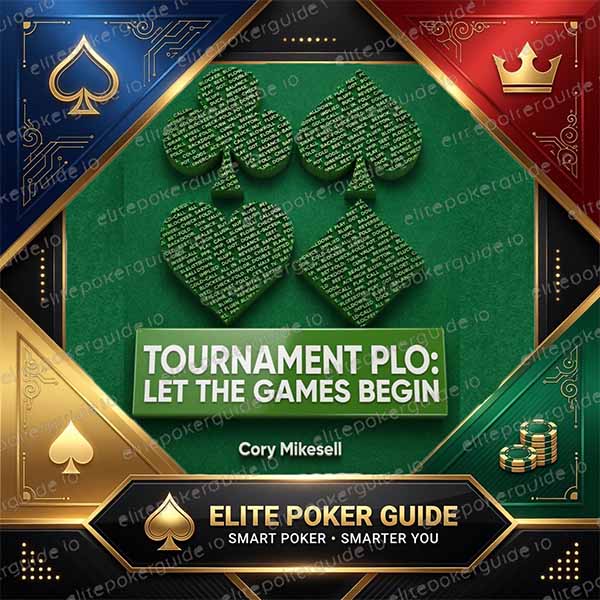
CORY MIKESELL TOURNAMENT PLO
Original price was: €399.00.€39.99Current price is: €39.99.
 Rare dedicated PLO tournament strategy book by Cory Mikesell
 Includes extensive Monkersolver and PLO Genius analysis Covers ICM, fold equity, stack leverage, PKO, satellites, HU, and example hands Built from serious high-stakes tournament study material Includes Anki cards to train key tournament PLO frequencies Instant download. FOREVER LICENSE. Lifetime access. No subscriptions.
Why Tournament PLO Needs Its Own Strategy
The book opens with a clear warning: PLO tournaments are volatile, difficult, and capable of producing brutal long-term variance. Cory Mikesell explicitly frames the format as one where massive downswings are normal and where players need to understand the “insanity” of tournament PLO before taking it seriously.
That matters because many players approach PLO tournaments incorrectly.
Cash PLO players often think their postflop edge will carry them through. No-Limit Hold’em tournament players often understand ICM but underestimate how different PLO hand values and equity structures are. Some players simply gamble for a big stack and call that strategy.
The book attacks all of these mistakes.
Its central message is that tournament PLO must be understood through stack depth, fold equity, ICM pressure, and range construction. You are not just trying to play beautiful Omaha hands. You are trying to understand when chips are worth more, when chips are worth less, when pressure matters, when preserving stack utility matters, and when the player taking the aggressive action has a structural edge.
The Core Concept: Fold Equity Is Everything
One of the strongest ideas in Cory Mikesell Tournament PLO is simple but extremely powerful:
Fold equity drives tournament poker.
The book explains that RFI ranges, 3-bet ranges, flop bets, stack-off decisions, and many short-stack choices are built around the ability to make opponents fold. This becomes even more important in tournaments than in cash games because stacks are finite, payouts matter, and pressure changes how hands should be played.
The practical lesson is that you usually want to be the player shoving, not the player calling off.
That single idea changes a lot:
With 20–25bb, the book discusses min-opening when a chip leader is behind so that you preserve the ability to 4-bet shove.
With 15bb in the small blind, limping can become attractive because it preserves a limp/reraise option.
With 35–40bb, pot-opening can create a stack geometry that allows a strong 4-bet shove.
With SPR around 3–4 postflop, checking range can sometimes preserve the ability to check-shove.
With 5–7bb UTG, the book warns that fold equity is low, so the player may need to play tighter than solver output suggests and look for better overlay spots from the blinds.
This is the kind of framework that can immediately reshape how a player thinks about tournament PLO. The goal is not to memorize one chart. The goal is to understand leverage.
The Book’s Solver-Based Structure
A major strength of the book is the way it presents solver work.
Cory Mikesell uses Monkersolver data and converts parts of that data into what he calls strategy graphs. These graphs organize hands by equity, frequency, and practical hand classes so that solver solutions become more human-readable.
The book also uses PLO Genius categories for preflop hand classification, which helps make the analysis more structured. Instead of treating every four-card combination as an isolated case, the material groups hands into categories that can be studied and compared.
That is important because PLO is too complex to learn by raw memorization. Players need pattern recognition.
The book’s structure helps readers see:
How different hand classes appear in ranges
How betting frequencies change by hand type
How raise/call/fold decisions appear in facing-bet charts
How ICM changes preflop composition
How stack sizes distort normal chip EV strategy
How postflop strategy changes when ranges become strange preflop
This makes the book especially useful for players who already study with solvers or want to start understanding solver output in a more practical way.
ICM, Limitations, and Real Tournament Thinking
One of the most honest parts of the book is its discussion of limitations.
Mikesell does not pretend that ICM or Monkersolver can perfectly model every tournament situation. The book explains that ICM is useful because it recognizes that chips change value depending on the prize structure, but it cannot fully project future game dynamics.
For example, ICM may not fully understand what happens when one player builds a massive bubble stack and then repeatedly attacks the table. It also does not perfectly model multi-table remaining-field situations.
The book also points out practical limitations in postflop ICM study. It explains that preflop and flop play can be studied with higher confidence, but turn and river accuracy becomes more difficult. Instead of pretending every answer is exact, the book focuses on big takeaways that can make players stronger immediately.
This is one reason the book feels more useful than a pure chart dump.
It does not say: “Here is every answer.”
It says: “Here is how to think.”
That is the correct direction for serious tournament poker study.
RFI Sizing and Stack Geometry
The section on RFI sizing is especially valuable because it connects preflop size directly to tournament leverage.
In theory, PLO preflop opening is often pot-sized, with a ¾ pot size sometimes appearing between 30–50bb. But the book explains practical exceptions.
At very tight tables, opening smaller can punish overfolding.
When a micro stack is behind, smaller sizing can preserve the ability to reopen action after a jam.
Near the bubble, with a big stack directly behind and a 12.5–25bb reshove stack, min-raising can make the chip leader’s 3-bet less clean and preserve a 4-bet shove option.
With extremely short stacks, such as around 3bb, min-opening may sometimes preserve the possibility of folding to heavy action behind in special bubble situations.
This is tournament poker at a deeper level. The important point is not “always min-raise” or “always pot.” The important point is that sizing must serve stack geometry, fold equity, and future action.
That is the kind of thinking that separates serious tournament players from players who only copy static ranges.
Preflop Skill: Recognize the Situation
The book identifies two major preflop skills:
Recognize the situation and understand the correct RFI percentage.
Execute opening ranges of different widths.
That sounds simple, but in PLO tournaments it is not. A 30% range and a 65% range can look very different depending on stack depth, antes, position, ICM pressure, and the players behind.
The book also includes Anki cards to help train preflop frequency recognition. That is a practical addition because tournament PLO requires instinctive recognition. You cannot stop during a hand and rebuild your entire theory tree.
You need trained pattern recognition.
This is where the book’s study value becomes clear. It is not only a reading product. It is designed to help players build decision-making instincts.
Postflop Lessons: Small Pots, Air, Block Bets, and Isolation
The postflop recommendations are practical and direct.
The book says players often bluff less in position and less in single-raised pots. It warns against vague statements like “my opponents don’t bluff” and pushes players to think in specific lines instead.
It recommends betting more air in spots where players fail to polarize enough.
It emphasizes attacking small pots, especially lines where players overfold or play too passively.
It recommends using small blocking sizes out of position, noting that when you bet ¼ pot, the opponent must defend a very large portion of range to prevent automatic profit.
It also warns against isolating too wide after limps, especially for players coming from NLH who may feel obligated to punish limpers with too much of their range.
These lessons matter because tournament PLO is not only about massive all-ins. Small pots, delayed c-bets, river block bets, and missed bluff opportunities can quietly decide whether a player survives with leverage or bleeds down into desperation.
Player Types You Will Face
The book breaks PLO tournament opponents into several broad groups:
Cash PLO players
NLH tournament players
“Gamble to get a big stack” players
Wizards
This section is extremely useful because it explains why different opponents make different mistakes.
Cash PLO players may play well early but struggle when bubble pressure and ICM distort normal strategy.
NLH tournament players may understand ICM but misunderstand PLO hand strength, overvalue certain holdings, or misplay 3-bet pots.
Gamblers may chase a big stack too aggressively and underestimate the cost of burning entries.
Strong players require a closer-to-optimal approach.
The key lesson is not to label every opponent lazily. The book recommends looking for specific weaknesses: underbluffing certain lines, overfolding delay c-bets, failing to adjust preflop, calling too wide against 3-bets, or misunderstanding low SPR.
This is exactly the kind of population-aware thinking that serious players need.
PKO Tournaments and Bounty Power
The book treats PKO tournaments as normal tournaments with additional math.
On top of ICM, players must account for bounty value. The book explains this through the idea of bounty power: converting the bounty into chip value and adding it to pot-odds logic.
In PKOs, ranges can change dramatically.
Players may RFI wider when covering opponents and tighter when covered. Bounties can create overlays that make call-offs wider. But the book also warns that bounty power becomes less precise as ICM influence grows.
The practical message is clear:
PKO PLO is not just “play loose and collect bounties.” It is a format where bounty incentives, covering power, ICM, and stack depth all collide.
That makes this section especially useful for modern online tournament players, because PKO formats are now a major part of tournament schedules.
Satellite Strategy: Preserve the Stack, Win Without Fighting
The satellite section is one of the clearest examples of how PLO tournament strategy can become counterintuitive.
The book explains that satellites are about taking down pots without a fight and preserving stack value. Near the bubble, some hands that look strong in normal PLO can become folds, while hands with better fold-equity properties can become more useful.
The point is not that one specific hand always plays one way. The point is that payout structure changes everything.
In a satellite, the goal is not to accumulate all the chips. The goal is to secure a seat. That means stack preservation, fold equity, and pressure awareness can matter more than raw hand beauty.
This is exactly why tournament PLO needs its own study material.
Who Should Buy Cory Mikesell Tournament PLO?
Cory Mikesell Tournament PLO is best for players who want serious, technical study.
It is ideal for:
PLO players moving into tournaments
MTT players who want to understand PLO-specific stack dynamics
Players studying ICM, PKO, satellites, and bubble pressure
Solver users who want Monkersolver and PLO Genius-based strategic interpretation
High-stakes and ambitious mid-stakes players who need deeper tournament frameworks
Players who want structured study material with example hands and Anki frequency training
It is probably not ideal for total beginners who still need basic PLO rules, simple hand selection, or elementary postflop concepts.
Related Products

High Stakes Course by MMAsherdog BluffTheSpot
RUN IT ONCE PADS ON PADS + Updated 2023

POKER DETOX PD NIGHT VISION EXPANSION – Cash Poker Courses Cheap


Original price was: €399.00.€39.99Current price is: €39.99.